

Luna demonstrates a fashion persona across an evening scene and a backstage-style image. That is visual concept evidence, not proof of sales, audience growth, or production reliability.
Published September 5, 2026. Evidence type: internal concept case study. Method: editorial review of two selected public images and the portfolio’s stated scope. This is not a customer campaign, an independent audit, or a controlled generation benchmark.
The case in one minute
Luna Solano is an owned synthetic persona presented by 404 Models for fashion, beauty, and lifestyle work. In this review, the useful result is specific: the public portfolio shows an evening dining concept and a backstage-style beauty scene under one named identity. It does not show whether a brand sold more products, how often generation failed, or what each approved image cost.
For a fashion buyer, this distinction changes procurement. The portfolio can start a conversation about art direction. It cannot replace a test using the buyer’s actual garments, required poses, usage terms, and commercial objective.
The brief represented by the concept
The stated direction combines luxury styling with a social, creator-like presence. The potential job is a recurring identity for a product drop or editorial series, rather than a one-off anonymous render. Our review asks whether the two selected images communicate that direction, and which decisions the images leave unresolved. We did not have the original generation log, rejected outputs, or a client-approved visual specification for this review.
Evidence 1: the evening scene
The first image uses a close portrait, dark clothing, a dining setting, and a glass near the face. The face remains the focal point while the setting supplies a lifestyle narrative. This is a useful art-direction reference for an evening-fashion concept; it is not evidence of a real dinner, product use, or endorsement.
A production brief should explicitly review the glass and hand interaction, reflections, clothing edges, and the intended audience. Alcohol-associated staging may not suit a campaign, even when the garment itself is the subject. The lesson is to assess the surrounding scene as part of brand fit, not just approve an attractive portrait.
Evidence 2: the backstage-style scene
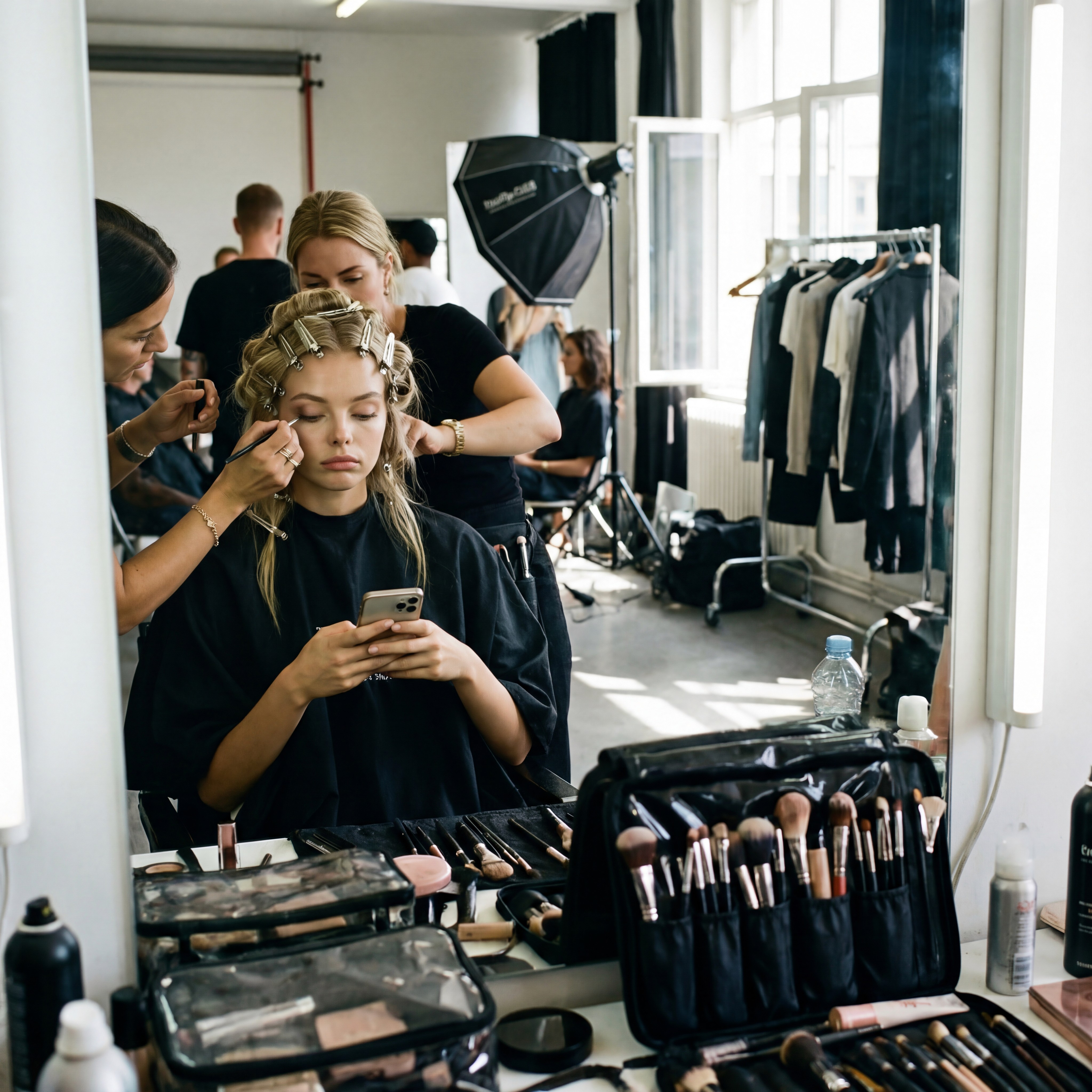
The second selected image depicts makeup preparation, mirrors, styling equipment, and other figures. It supplies a different narrative context from the evening image. Because this scene looks like an event record, the publication context should make its synthetic nature clear. A backstage-looking image must not be used to suggest an actual fashion-show appearance or a real collaboration that did not occur.
The two pictures are not matched test conditions: lighting, hair arrangement, framing, and environment differ. We therefore do not calculate an identity-consistency percentage from them. A reviewer can discuss continuity, but reliable production requires an approved reference set and a defined scoring method.
What we established, and what we did not
Established on September 5: the public CMS record contained two main images and nine gallery entries for Luna, excluding the archive preview. We visually reviewed the two main images for this case study. The nine gallery entries are an inventory count, not nine additional scored observations. The public model page identifies Luna as synthetic.
Not established: generation success rate, production time, approval rate, product fidelity, audience sentiment, incremental sales, or ownership of every underlying element. No campaign export, cost ledger, controlled audience test, or rights audit is included here. Portfolio selection can hide failed attempts, so selected images cannot establish workflow reliability.
A useful next pilot for a fashion brand
Our proposed pilot would keep one approved garment and one identity reference set fixed across front, profile, three-quarter, and full-length views. Repeat each view in a neutral studio and the intended campaign setting, with two independently generated outputs per condition: 16 outputs in total. This is a practical starter design, not a statistically validated sample size or a completed test.
Retain all 16 outputs. Before generation, define hard failures for garment shape, color, logo, identity, anatomy, and misleading scene context. Record regeneration attempts, retouching minutes, and reviewer decisions. Two reviewers should first assess independently, then record how disagreements were resolved. A garment-fidelity failure should not be averaged away by a high aesthetic score.
Use the character consistency test protocol
Commercial decision rule
Move from concept to a paid pilot only after the brand accepts the visual canon, product-fidelity requirements, rights scope, disclosure approach, and total production budget. If those checks pass, test a defined commercial hypothesis against existing creative. Track approved assets and costs separately from sales, and distinguish attributed orders from incremental lift. This case study supplies an inspectable starting point, not a promise that an AI persona will outperform human talent.
Model the investment and break-even assumptions
Sources and review boundary
Primary material: the Luna portfolio, its two main source images, and the public-facing CMS asset inventory reviewed September 5, 2026. 404 Models created the concept and performed this editorial review, so it is first-party evidence. No client results, private social analytics, or paid-media outcomes are claimed. The pilot design above is our proposed next experiment, not a report of work already completed.
Compare the Cat beauty concept case study
More AI influencer research.
Source-backed guidance on brand-owned AI influencers, synthetic media governance, creative testing, and measurement.